Space Phasor
Introduction
A space phasor, often encountered in the context of electrical engineering, particularly in the study and analysis of three-phase electrical systems, is a mathematical tool used to represent the spatial relationship and magnitude of vectors (such as magnetic fields, voltages, and currents) that are distributed in space. Essentially, it is a way to simplify the analysis of systems with multiple phases by combining them into a single complex vector [1].
In more technical terms, a space phasor is constructed from the instantaneous values of the physical quantities in a multiphase system, typically a three-phase system. It represents these quantities as a complex number (phasors), which captures both the magnitude and the phase angle in a two-dimensional plane. This approach enables the representation of the system’s behavior in a more intuitive and analytically convenient form, especially when dealing with sinusoidally varying signals.
\(abc\) Stationary Frame
To clarify the concept of the space phasor, consider the following three phase, sinusoidal function in the \(abc\) frame
where \(A(t): \mathbb{R}_+ \to \mathbb{R}_+\) represents the amplitudes, \(\omega\) is the angular frequency, \(\phi\) is the initial phase, and \(\{a,b,c\}\) subscripts indicate the corresponding phase. The function \(\vv{f_{abc}} = [f_a, f_b, f_c]^{\top}\) can represent different variables in three-phase systems, such as current, voltage, and magnetic flux, as a vector in the three-dimensional \(abc\) frame. For the given three-phase sinusoidal functions in (27) we define the corresponding phasor representation for each phase as follow [1]
Employing the Euler’s identity \(e^{j\phi}=\cos{(\phi)} + j\sin{(\phi)}\), it is easy to verify that the following relationship holds between the three-phase sinusoidal functions in (27) and their phasor representation (28)
Although phasor notation in (28) can be used for circuit analysis, it becomes more complex in cases where the system is unbalanced-that is, when the amplitudes \(\{A_a,A_b,A_c\}\) are not equal and the phases \(\{\phi_a,\phi_b,\phi_c\}\) are not distributed \(120^\circ\) apart. The presence of imbalances complicates the analysis of multiphase systems. However, we can gain deeper insight into the system and further simplify the analysis by rewriting (28) in terms of phasors with a specific spatial structure known as symmetrical components. This method, developed by Charles Legeyt Fortescue in 1918, decomposes complex unbalanced three-phase systems such as (28) into three separate sets of balanced systems: positive sequence \([f_a^+, f_b^+, f_c^+]^{\top}\), negative sequence \([f_a^-, f_b^-, f_c^-]^{\top}\), and zero sequence \([f_a^0, f_b^0, f_c^0]^{\top}\) [3]
where the positive, negative, and zero sequence are defined as
Each set represents a different aspect of the power system’s behavior. The positive sequence components reflect the balanced normal operation of the system, where the phase voltages are equal in magnitude and evenly spaced by 120 degrees. The negative sequence components arise in situations of unbalance, representing voltages that are equal in magnitude but opposite in phase sequence to the positive sequence. Lastly, the zero-sequence components account for scenarios where currents return through the neutral or ground, often occurring during faults [3]. We can represent the positive, negative, and zero sequence more succinctly as
where \(a=e^{j2\frac{\pi}{3}}\) is the Fortescue phase-shifting operator, \(\vv{f^0} = A^0 e^{j\phi^0}\), and \(\{\vv{f^+}, \vv{f^-}\}\) are space-phasor defined as
Combining (28) and (30) we have the following linear transformation between the positive, negative, and zero sequences and \(abc\) phasors
\(\alpha\beta\) Representation of Space Phasor
We have covered the concept of space phasors for depicting three-phase signals and have detailed the method to express asymmetric three-phase signals using balanced positive, negative, and zero sequences. Up until now, our calculations have utilized polar coordinates, a method that directly addresses the amplitude and phase of complex-valued functions. However, for the purposes of control design and implementation, converting space phasors and their equations from polar to Cartesian coordinates proves to be more practical. This conversion allows us to work directly with real-valued functions of time, although it means that we lose the ability to directly adjust the magnitude and phase of the phasors. In this section, we will introduce the process of mapping a space phasor onto the Cartesian coordinate system, a technique often referred to as the \(\alpha\beta\)-transform in technical discussions [1].
We start by considering a three-phase system in which only the positive and zero sequences are present. That is, we have \(\vv{f^-} = 0\) and therefore
Above equation, underscores the relationship between the phasors in the \(abc\) frame and the Cartesian coordinates of \(\vv{f^+}\) and \(\vv{f^0}\) denoted by the real valued functions \(\{f_{\alpha}^+, f_{\beta}^+\}\) and \(\{f_{\alpha}^0, f_{\beta}^0\}\).
The coordinate transform in (32) is useful for the circuit analysis of three-phase systems. However, for control purposes, we only have access to the three-phase sensor measurements that, based on (27) and (28), are equal to the real part of the space phasors \(\{\vv{f_a},\vv{f_a},\vv{f_c}\}\). Therefore, it is desirable to find the \(\alpha\) and \(\beta\) components of \(\vv{f^+}\) and \(\vv{f^0}\) in terms of \(\vv{f_{abc}}\) in (29). Applying the real-part operator \(\Re\) to both sides of (32) we get
where we have used \(\Re(f^+) = f^+_\alpha\), \(\Im(f^+) = f^+_\beta\), \(\Re(f^0) = f^0_\alpha\), and the identity \(\Re(Z_1 Z_2) = \Re(Z_1)\Re(Z_2) - \Im(Z_1)\Im(Z_2)\). Based on (33) we obtain the linear transformation between the \(\alpha\) and \(\beta\) components of the positive and zero sequence and the three-phase measurements as follow
The transformation, \(T_{\alpha\beta0}\), of three-phase signals \({f_a, f_b, f_c}\) into the \(\alpha\beta 0\) format in (34) is called the \(\alpha\beta 0\) transformation, or the Clarke transform [1]. Following this, converting the \(\alpha\beta\) components of the positive and zero sequences back into the \(abc\) signals is known as the inverse \(\alpha\beta 0\) transformation or the inverse Clarke transform denoted by \(T_{\alpha\beta0}^{\text{-}1}\) in (34).
The Clarke transform in (34) was derived under the assumption that the \(abc\) phasors \(\{\vv{f_a}, \vv{f_b}, \vv{f_c}\}\) are only composed of positive and zero sequences. In this case, we are guaranteed to be able to reconstruct the positive sequence space phasor \(f^+ = f_{\alpha}^+ + jf_{\beta}^+\) from our \(abc\) signals \(\{f_a,f_b,f_c\}\) and also to obtain the \(f_\alpha^0\) component of the zero sequence. Note that to reconstruct the zero sequence phasor \(f^0 = f_{\alpha}^0 + jf_{\beta}^0\), we need to use the orthogonal signal generator to construct \(f_\beta^0\) from \(f_\alpha^0\). However, if our \(abc\) phasors are made up of positive, negative, and zero sequences, then (34) does not hold. We demonstrate this by considering general three-phase signal with positive, negative, zero sequences present as follow
Applying the Clarke transform in (34) to the above \(abc\) signals we arrive at the following \(\alpha\beta 0\) representation of the signal
Clearly, the \(\alpha\) component from the Clarke transformation is the sum of the \(\alpha\) components of both positive and negative sequences, while the \(\beta\) component is derived from the difference between the \(\beta\) components of positive and negative sequence.
Although the \(\alpha\beta\) representation of an unbalanced three-phase signal does not clearly differentiate between the \(\alpha\beta\) components of the positive and negative sequences, knowing the phasor frequency \(\omega\) allows us to separate these sequences by frequency in the rotating \(dq\) frame. This concept will be explored further in the next section.
\(dq\) Representation of the a Space Phasor
The \(dq\) rotating frame is a two-dimensional orthogonal coordinate system embedded within the \(\alpha\beta\) stationary frame. The representation of the \(\alpha\beta\) rotating phasor in the \(dq\) frame coordinates offers several distinct advantages. At the heart of its benefits, the \(dq\) frame allows AC signals to assume DC or a slowly varying waveform under steady-state conditions [1]. This simplification is crucial because it allows the use of control strategies and compensators that are effective for systems with primarily DC signals. These compensators typically assume a simpler structure and lower dynamic orders in the \(dq\) frame compared to their \(\alpha\beta\) counterpart [2].
The \(dq\) reference frame aligns with the unit vectors \(e^{j\theta_{dq}(t)}\) and \(e^{j(\theta_{dq} + \frac{\pi}{2})}\), where the angle \(\theta_{dq}\) specifies the orientation of the \(dq\) frame as shown in Figure 33. For any given \(dq\) rotating frame, characterized by the angle \(\theta_{dq}\), and an arbitrary \(\alpha\beta\) phasor \(\vv{f_{\alpha\beta}} = f_{\alpha} + jf_{\beta}\), the \(\alpha\beta\) to \(dq\) transformation is defined as
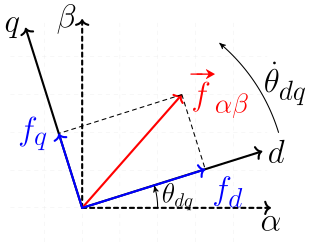
Figure 33 The orientation of \(dq\) rotating frame is uniquely defined by the angle \(\theta_{dq}\). Matching the angular frequency of \(dq\) frame with that of a rotating phasor allows us to treat the rotating phasor as a stationary vector in the \(dq\) frame.
Additionally, we obtain the \(dq\) to \(\alpha\beta\) transformation by multiplying both sides of the equation above by \(e^{j\theta_{dq}}\) to get
Referring to equation (36), the transformation from the \(\alpha\beta\) frame to the \(dq\) frame involves rotating the vector \(\vv{f_{\alpha\beta}}\) by an angle of \(-\theta_{dq}\).
To understand the significance of the \(dq\) transformation, consider a rotating phasor \(\vv{f_{\alpha\beta}} = A(t)e^{\phi(t)},\) where
In a scenario where the angular frequency of the \(dq\) frame matches that of the rotating phasor, which means \(\dot{\theta}_{dq}(t) = \dot{\phi}(t) = \omega(t)\), the orientation \(dq\) frame is determined by:
leading to a simplified expression for the \(\vv{f_{dq}}\) in the \(dq\) frame as:
In this context, \(\vv{f_{dq}}\) acts as a stationary vector within the \(dq\) frame. It is important to clarify that the term ‘stationary’ in this context means that the vector does not rotate in relation to the \(dq\) frame; however, the vector’s magnitude, \(A(t)\), can be a function of time. This feature of the \(dq\) rotating frame provides us with a powerful tool to treat the amplitude of sinusoidal signals as DC-like signals for the purpose of closed-loop control reducing the complexity of controllers.
Finally, the \(\alpha\beta 0\) to \(dq0\), and \(dq0\) to \(\alpha\beta 0\) transformation in (36) and (37) can be written in vector form using the Euler’s identity as follow
The above matrix transformation between the \(\alpha\beta\) frame and the \(dq\) frame is suitable for embedded implementations.
Frequency separation of positive and negative sequence: The transformation from the \(\alpha\beta\) to the \(dq\) frame enables us to achieve frequency separation between the positive and negative sequences of three-phase symmetric components. To illustrate this more clearly, consider the \(dq\) components of a general unbalanced system as described in (35) as follow
Note that the positive sequence leads to a rotating phasor in the \(dq\) frame with frequency \(\omega t - \dot{\theta}_{dq}\), while the negative sequence manifests itself as a phasor with frequency \(-\omega t - \dot{\theta}_{dq}\). In a special case where the frequency of \(dq\) frame is matched with that of the phasor \(\theta_{dq} = \omega t + \theta_{dq}(0),\) we get
This concept is especially significant because in the \(dq\) frame, the positive sequence is represented as a stationary vector, while the negative sequence appears as a phasor with a frequency that is twice that of the rotating frame’s frequency.
This aspect is particularly crucial when designing control systems that aim to achieve fault ride-through capabilities. Given that negative sequence components are prominently present during fault conditions, this characteristic must be factored into the control system design. A prime example of utilizing this principle is the state-of-the-art Decoupled Double Synchronous Reference Frame (DDSRF) PLL, which leverages this behavior to accurately determine the frequency of the grid even in the middle of a fault [4].
One of the key concepts that emerged during the analysis of the \(dq\) frame is the synchronization of the \(dq\) frame with a rotating phasor. This feature is fundamental to the \(dq\) rotating frame, as it enables the transformation of rotating phasors into stationary vectors within the \(dq\) frame. However, to achieve synchronization of frequency and/or phase with the rotating phasor, we must implement a dynamic system known as a Phase-Locked Loop (PLL).
Phase-Locked-Loop (PLL)
label{subsection:Phase_Locked_Loop}
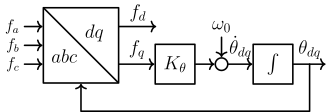
Figure 34 Conventional 3-phase PLL system that include \(abc\) to \(dq\) transform, PLL loop filter \(K_\theta\) and voltage controlled oscillator (VCO) (integrator).
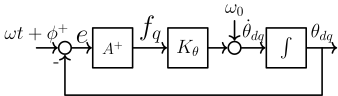
Figure 35 Linearized model of the PLL in (a) that is frequently used for stability and performance analysis of the PLL.
A Phase-Locked Loop (PLL) is a closed-loop system, widely used in communication and control systems, to synchronize an output signal’s phase and frequency with a reference signal’s phase. This is achieved through a feedback loop mechanism. The main components of a PLL, such as one shown in Figure 34, include a phase detector, which compares the phase of the input signal with that of the oscillator signal; a loop filter \(K_\theta\), typically a PI controller; and a voltage-controlled oscillator (VCO), which is a simple integrator to recover the phase from the frequency.
In a three-phase system, the phase detector is a \(abc\) to \(dq\) transform. For a balanced three phase signal \(\vv{f_{abc}}\), consisting of only of positive component, the output of the phase detector (\(abc\) to \(dq\) trasform) is
where \(\omega\) and \(\phi^+\) are frequency and phase of rotating phasor, \(A^+\) is the magnitude of the phasor and \(\theta_{dq}\) represent the orientation of the \(dq\) frame. Under phase synchronizaiton, that is \(\omega t + \phi^+ = \theta_{dq}\), we have \(f_d = A^+\) and \(f_q = 0\). Therefore, it is desirable to construct a feedback mechanism to regulate \(f_q\) to zero. This is facilitated by considering the small-angle linear approximation of \(f_q \approx A^+(\omega t + \phi^+ - \theta_{dq})\). This is only true when the phasor angle, \(\omega t + \phi^+\), is close to the \(dq\) frame orientation \(\theta_{dq}\). In this case, \(f_q\) acts as a scaled feedback error between the phasor angle, \(\omega t + \phi^+\), and \(\theta_{dq}\). This allows for the application of the closed-loop model depicted in Figure 35. The closed-loop system should effectively track the ramp input reference with zero steady-state error. This is equivalent to satisfying the following final value theorem
Therefore, a necessary and sufficient condition for synchronization is that \(K_\theta\) includes at least one integrator. Consequently, a simple PI compensator, used as a loop filter, \(K_\theta\), can achieve synchronization. In what follows, we give a simple criterion to design \(K_\theta\) to achieve the desired transient response.
Design of Loop-Filter: We consider loop filter of simple PI form
To design for parameters \(k_p\) and \(k_i\) we consider the corresponding closed-loop transfer function between input and output as follow
Above closed-loop represents a simple second order uinty gain system with natural frequency and damping given by
It is evident that based on the required closed-loop bandwidth and damping factor, we can compute the corresponding PI parameters \(k_p\) and \(k_i\).
Note
It is important to note that both the natural frequency and damping of the closed-loop system depend on the square root of the phasor’s magnitude. Given that the magnitude of the phasor can vary, it is crucial to determine the minimum damping required for the worst-case scenario, which is when the phasor’s magnitude is at its smallest.
Power in \(abc\), \(\alpha\beta\), and \(dq\) frame
Power is a fundamental variable of interest in power systems. However, power is measured indirectly through voltage and current readings. Therefore, it is crucial to derive the expressions for both active and reactive power across all three frames: \(abc\), \(\alpha\beta\), and \(dq\). This allows for comprehensive analysis and control within these different coordinate systems.
The instantaneous active and reactive power in \(abc\) frame is [1, 5]
In the definition of instantaneous active and reactive power provided above, the voltages \(\{v_a,v_b,v_c\}\) and currents \(\{i_a,i_b,i_c\}\) do not necessarily need to be balanced. However, it is assumed that the sum of the currents across all three phases equals zero, that is, \(i_a + i_b + i_c = 0\) [1].
Considering the definition of voltage and current phasor, the power can be written in terms of phasor quantities as
Using the identity \(\Re(Z_1)\Re(Z_2) = \Re(Z_1 Z_2)/2 + \Re(Z_1 Z_2^*)/2\) we can further simplify above equation as
Applying \(e^{j0} + e^{-j\frac{4\pi}{3}} + e^{j\frac{4\pi}{3}} = 0\), we can express active and reactive power in an elegant manner using voltage and current phasors as follow
To obtain the power in the \(\alpha\beta\) frame replace \(\vv{v} = v_{\alpha} + jv_{\beta}\) and \(\vv{i}^* = i_{\alpha} - ji_{\beta}\) into (38) and (ref{eq:reactive_power_final}) to get
The power in \(dq\) frame is obtained in same fashion by replacing \(\vv{v} = (v_d + jv_q)e^{j\theta_{dq}}\) and \(\vv{i}^{*} = (i_d - ji_q)e^{-j\theta_{dq}}\) into (\ref{eq:Active_Reactive_Power}) to get
Generating the current reference: The active and reactive power formulas in (39) and (40) are used to calculate the power based on the voltage and current measurements. However, for control applications, it is also essential to generate current references based on the active and reactive power set-points. Consequently, we need to establish a transformation from active and reactive power to current components. This transformation can be derived using the relations given in (39) and (40) as follow:
Although current reference generation in the \(\alpha\beta\) frame operates similarly to that in the \(dq\) frame, there is a nuanced difference. The voltage measurements in the \(\alpha\beta\) frame, represented as \(\{v_{\alpha},v_{\beta}\}\), are sinusoidal. Consequently, for constant power set points, the associated current set-points, \(\{i_{r\alpha},i_{r\beta}\}\), are also sinusoidal. In contrast, in the \(dq\) frame, voltages \(\{v_{d},v_{q}\}\) are DC quantities, which result in constant current set-points \(\{i_{rd},i_{rq}\}\).
This distinction significantly influences control design: the regulation of sinusoidal references typically requires a proportional resonant (PR) compensator [6], whereas constant set-points can be managed effectively with a simpler PI compensator. This demonstrates one of the primary advantages of using the \(dq\) frame in control systems, as it simplifies the control strategy required to maintain constant power outputs.
Amirnaser Yazdani and Reza Iravani. Voltage-sourced converters in power systems: modeling, control, and applications. John Wiley & Sons, 2010.
Mohammad Ebrahimi, Sayed Ali Khajehoddin, and Masoud Karimi-Ghartemani. Fast and robust single-phase $ dq $ current controller for smart inverter applications. IEEE transactions on power electronics, 31(5):3968–3976, 2015.
J Duncan Glover, Thomas J Overbye, and Mulukutla S Sarma. Power system analysis & design. Cengage Learning, 2017.
Pedro Rodríguez, Josep Pou, Joan Bergas, J Ignacio Candela, Rolando P Burgos, and Dushan Boroyevich. Decoupled double synchronous reference frame pll for power converters control. IEEE Transactions on Power Electronics, 22(2):584–592, 2007.
Fang Zheng Peng and Jih-Sheng Lai. Generalized instantaneous reactive power theory for three-phase power systems. IEEE transactions on instrumentation and measurement, 45(1):293–297, 1996.
Remus Teodorescu, Frede Blaabjerg, Marco Liserre, and P Chiang Loh. Proportional-resonant controllers and filters for grid-connected voltage-source converters. IEE Proceedings-Electric Power Applications, 153(5):750–762, 2006.